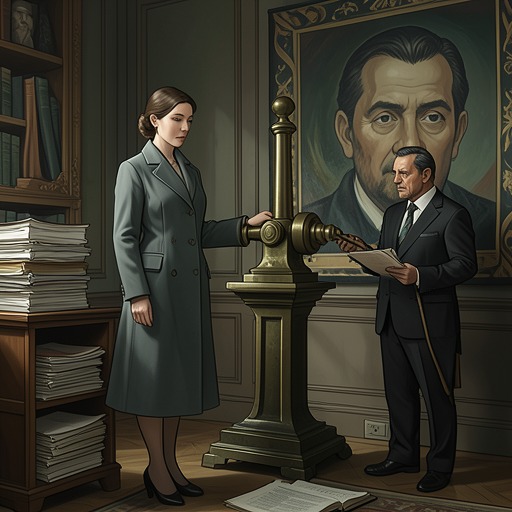
Hannah Wells Organization adoption database and files
Lost and FoundThe Hannah Wells Organization adoption database and files are the decisive archive at the center of Ransom’s search for his birth family. What begins as confidential institutional information, offered by Bethany as the price of a fake relationship, becomes the only practical route through which Ransom can move from an adopted identity and a changed name toward the names of his birth parents. The records do not simply preserve his past: they regulate who may see it, separate one part of his history from another, and make personal identity dependent on negotiated access.
Institutional Nature and Restricted Access
The records belong to the Hannah Wells Organization, a nonprofit adoption agency where Bethany works as an executive. She describes the organization as one that works to secure good placements for children who might otherwise have poor chances in the system, while acknowledging that adoption agencies can attract suspicion because of their money and institutional power. The database therefore carries a double meaning from its first appearance: it is an administrative resource intended to manage vulnerable children and families, but it is also a guarded store of intimate information whose misuse could threaten Bethany’s employment.
The archive contains more than a single adoption list. Bethany explains that it includes people who placed children for adoption, the children involved, donors, donation amounts, and tax information. Ransom’s initial request is deliberately broad: he wants secure access to files connected with the agency, and he offers to act as Bethany’s boyfriend, or even her husband, in exchange. Bethany immediately recognizes the ethical danger. She is not supposed to permit anyone without clearance to view secure files, does not know what Ransom intends to do with them, and worries that an action traced to her could cost her job.
The archive’s structure also determines what can and cannot be discovered. Records concerning adoptive parents are separated from the files concerning children who were minors at the time of adoption. Ransom needs both the record of the adopted child and the records of the birth parents, but these are held in distinct databases with distinct permissions. The separation protects sensitive information, yet it also fragments the identity Ransom is trying to reconstruct, forcing him to pass through the agency’s classifications one database at a time.
The Archive as a Bargained Resource
Bethany’s access to the files first becomes part of a confidential adoption-records bargain. Ransom rejects her offer of twenty-five thousand dollars and insists that information, rather than cash, is what he wants. He presents the exchange as a practical compromise: he will provide the convincing boyfriend Bethany needs for her high-school reunion, while she gives him controlled access to agency records. Bethany’s fear that she could be fired keeps the bargain morally unstable, even when Ransom assures her that he will not use the information for anything that could be traced back to her or for anything that would hurt people.
Bethany eventually weighs the risk against the image she wants to project at the reunion. She knows she is allowing a stranger to stay at her parents’ house, pose as her boyfriend, and enter confidential work information, but she also believes she can withdraw the arrangement, pay him instead, or call the police if he proves dangerous. Her consent is therefore neither casual nor fully secure. It is produced by competing pressures: professional duty, the desire to make a spectacular return to her old school, and her growing judgment that Ransom is not truly bad.
The bargain is later narrowed and renewed through physical intimacy. Ransom proposes an orgasm wager in which Bethany’s access to the adoptive-parent files becomes the consequence of his success. When she asks what he actually wants, he identifies two connected sets of records: the files on adoptive parents and the records of parents who gave children up for adoption, together with the names of children placed by the agency. After Bethany grants him access to the adoptive-children database, she logs into the secure company website and gives him the laptop, choosing not to watch over his shoulder. The archive thus becomes entangled with an intimate exchange in which professional authority, bodily vulnerability, curiosity, and trust are repeatedly traded against one another.
Ransom’s Search Through the Files
Ransom’s urgency comes from a closed adoption that public records cannot unlock. His parents adopted a child from the agency roughly twenty years earlier, but Ransom does not know the child’s pre-adoption name or the birth parents’ identities. Searches of ordinary public records have failed, and a family-court clerk has warned him that old paperwork may have been destroyed or that the relevant material would remain with the agency. The Hannah Wells Organization’s files are therefore not merely convenient; they are probably the last surviving institutional path to the missing information.
Bethany later gives Ransom separate login details for the adopted-children database and the database concerning parents who gave children up for adoption. She warns him not to use the credentials elsewhere, because locking her out would force her to explain what happened. She also tells him to use her laptop because the system recognizes it as authorized. With the reunion group occupied elsewhere, Ransom returns to the hotel room, enters Bethany’s personal password, and opens the page titled Children Served by Us.
The first search is uncertain because Ransom does not know whether the system indexes him under his adoptive name or his name before adoption. He finally enters Patrick Nolan, a name he stopped using about five years earlier. The search initially appears to produce no result, but then reports that one result has been found. The file contains a photograph of a three-year-old child and identifies Janice and Raymond Nolan as the adoptive parents. Ransom recognizes them as his own parents and confronts his history in the language of an institutional record.
The file identifies Ransom as a two-year-old child given up by birth parents and records that he was assessed as above-average in intelligence, with minor behavioral issues described as consistent with an unstable attachment to birth parents. It also contains interview records made by the agency before he was sent home with his adoptive parents. Yet the birth parents’ names are absent from this file. The database confirms his past while withholding the exact information he wants, demonstrating that an archive can reveal identity through one field and preserve uncertainty through another.
Ransom then finds the name attached to his earlier identity: Patrick Cartwright. That discovery gives him the key needed for the second database. Searching the birth-parents records for Cartwright produces roughly half a dozen entries, but one entry is connected to his birth name and identifies Genevieve Cartwright and Alexander Cartwright. The names provide the missing link he has been seeking for years. He writes down their information, closes both databases, and begins external records searches using methods developed through previous odd jobs.
Consequences and Narrative Significance
The database changes Ransom’s search from an abstract question into an actionable investigation. Before access, he knows only that his parents adopted a child and that a closed adoption blocks him from ordinary legal and public records. After access, he possesses a sequence of documentary identities: Patrick Nolan as the name under which the agency filed him, Patrick Cartwright as his birth name, Janice and Raymond Nolan as his adoptive parents, and Genevieve and Alexander Cartwright as the names tied to his birth-family record.
The archive also exposes the difference between legal, adoptive, biological, and documentary kinship. Ransom’s relationship to Janice and Raymond Nolan is confirmed through the agency’s record of placement, while his connection to Genevieve and Alexander Cartwright appears through a separate birth-parent index. His identity is not recovered from one complete narrative but assembled across institutional categories, name changes, photographs, assessments, interviews, and cross-referenced databases. The records make kinship legible by dividing it into files and permissions, then allow Ransom to reconnect the divisions.
For Bethany, the files are a professional responsibility and a personal risk. Her friend Sarah’s suicide, after renewed contact with damaging birth parents, is one reason Bethany entered adoption work and believed that a genuinely caring family might have saved Sarah. That history gives the archive emotional weight beyond its bureaucratic function: the records concern the kind of family rupture that shaped Bethany’s career and now governs Ransom’s attempt to understand himself. Her decision to share access therefore places her ethical commitments directly beside another person’s need for origins.
The archive’s importance lies in this tension between protection and disclosure. Its restrictions exist because adoption information concerns minors, birth parents, adoptive families, donors, and tax records, all of whom possess claims to privacy. Yet those same restrictions leave an adopted adult dependent on institutional discretion to learn the facts of his own beginning. Ransom’s discovery is consequently both a triumph and a compromise: the files restore names that had been inaccessible for years, but only through an ethically fraught exchange in which Bethany’s job, trust, and authorization become part of the cost of recovering his identity.